
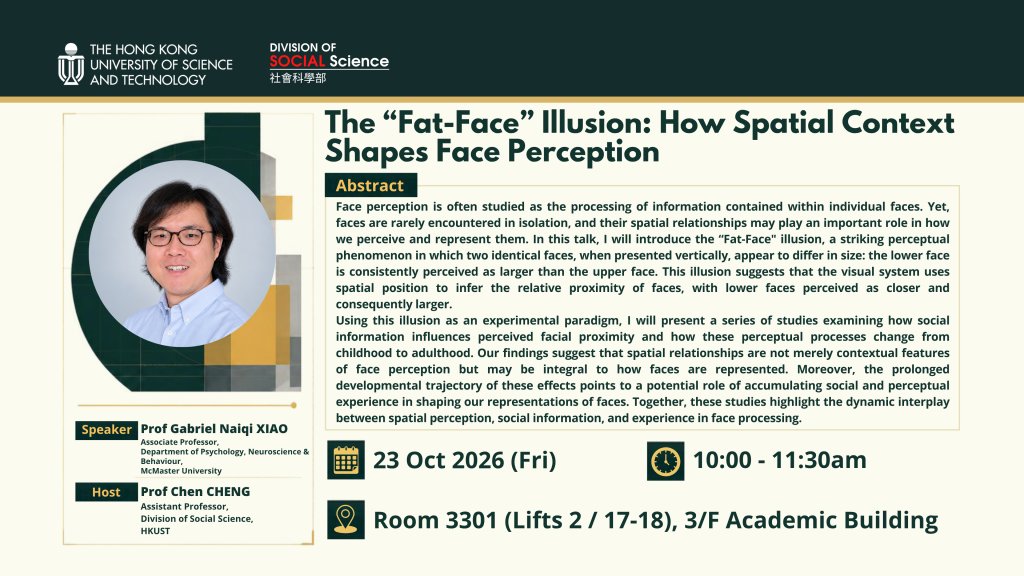
Face perception is often studied as the processing of information contained within individual faces. Yet, faces are rarely encountered in isolation, and their spatial relationships may play an important role in how we perceive and represent them. In this talk, I will introduce the “Fat-Face" illusion, a striking perceptual phenomenon in which two identical faces, when presented vertically, appear to differ in size: the lower face is consistently perceived as larger than the upper face. This illusion suggests that the visual system uses spatial position to infer the relative proximity of faces, with lower faces perceived as closer and consequently larger.
Using this illusion as an experimental paradigm, I will present a series of studies examining how social information influences perceived facial proximity and how these perceptual processes change from childhood to adulthood. Our findings suggest that spatial relationships are not merely contextual features of face perception but may be integral to how faces are represented. Moreover, the prolonged developmental trajectory of these effects points to a potential role of accumulating social and perceptual experience in shaping our representations of faces. Together, these studies highlight the dynamic interplay between spatial perception, social information, and experience in face processing.
Gabriel Xiao is an Associate Professor and University Scholar (2025–2030) in the Department of Psychology, Neuroscience & Behaviour at McMaster University. He earned his PhD at the University of Toronto and did postdoctoral work at Princeton before joining McMaster in 2020 as a Canada Research Chair. His lab uses eye tracking, brain imaging (fNIRS), and computational methods to study how early experience shapes the developing mind. They have shown that newborns' brains predict what they will see, that infants learn the statistics of the faces around them, and that these perceptual biases help explain how social biases first arise in infancy. His work appears in Psychological Science, Developmental Science, and Child Development, and is supported by Canada's national research councils for the natural sciences and the social sciences.
Host: Prof Chen CHENG, Assistant Professor, Division of Social Science, HKUST