
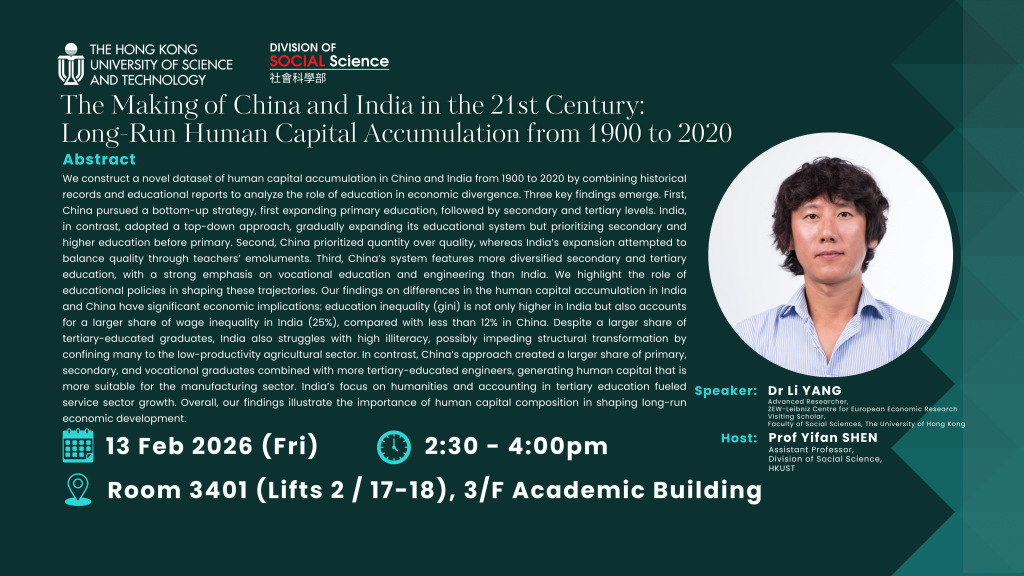
We construct a novel dataset of human capital accumulation in China and India from 1900 to 2020 by combining historical records and educational reports to analyze the role of education in economic divergence. Three key findings emerge. First, China pursued a bottom-up strategy, first expanding primary education, followed by secondary and tertiary levels. India, in contrast, adopted a top-down approach, gradually expanding its educational system but prioritizing secondary and higher education before primary. Second, China prioritized quantity over quality, whereas India’s expansion attempted to balance quality through teachers’ emoluments. Third, China’s system features more diversified secondary and tertiary education, with a strong emphasis on vocational education and engineering than India. We highlight the role of educational policies in shaping these trajectories. Our findings on differences in the human capital accumulation in India and China have significant economic implications: education inequality (gini) is not only higher in India but also accounts for a larger share of wage inequality in India (25%), compared with less than 12% in China. Despite a larger share of tertiary-educated graduates, India also struggles with high illiteracy, possibly impeding structural transformation by confining many to the low-productivity agricultural sector. In contrast, China’s approach created a larger share of primary, secondary, and vocational graduates combined with more tertiary-educated engineers, generating human capital that is more suitable for the manufacturing sector. India’s focus on humanities and accounting in tertiary education fueled service sector growth. Overall, our findings illustrate the importance of human capital composition in shaping long-run economic development.
Li Yang / 杨利 is an Advanced Researcher at ZEW - Leibniz Centre for European Economic Research. He is also a research fellow of the World Inequality Lab at the Paris School of Economics. Previously, he was a researcher in the World Bank DEC research group in Washington D.C. from 2013 to 2017, a Marie Curie research fellow at Paris School of Economics from 2018 to 2020. He was also the coordinator for East and South Asia at the World Inequality Lab from 2018 to 2021. His main research interests pertain to income and wealth inequality, economic history and political economy. His research output has been published in leading scientific journals in both economics and sociology such as American Economic Review, Journal of Economic Growth, Journal of Public Economics, World Development, the World Bank Economic Review, European Journal of Political Economy and the British Journal of Sociology. Owing to their relevance for ongoing public debates, his findings have also widely been discussed in diverse media outlets, such as the Economist, Foreign Affairs, Washington Post, the Wall Street Journal, Bloomberg, etc. Li Yang received his PhD in Economics in 2019 from Xiamen University, China.
Host: Prof Yifan SHEN, Assistant Professor, Division of Social Science, HKUST