
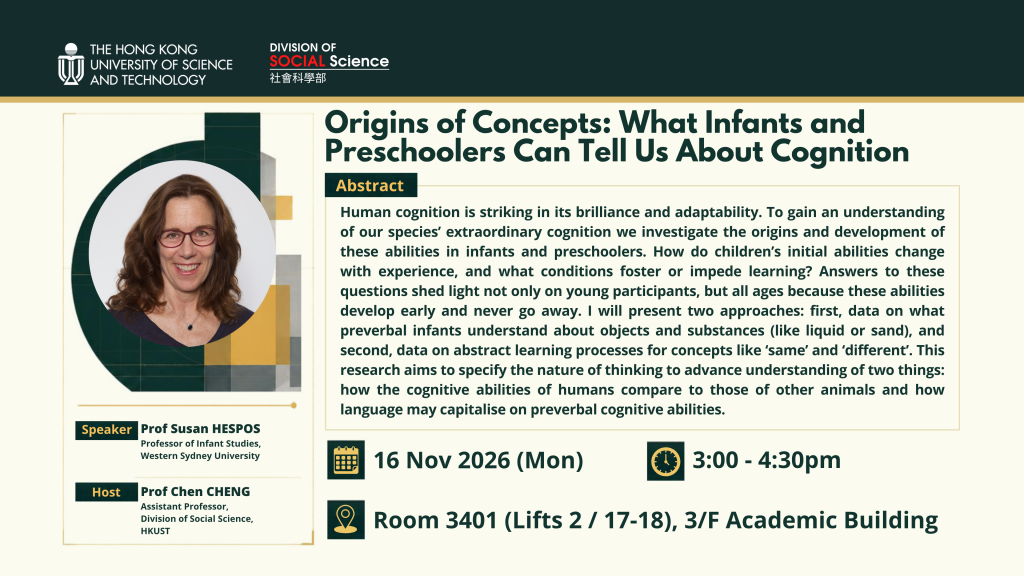
Human cognition is striking in its brilliance and adaptability. To gain an understanding of our species’ extraordinary cognition we investigate the origins and development of these abilities in infants and preschoolers. How do children’s initial abilities change with experience, and what conditions foster or impede learning? Answers to these questions shed light not only on young participants, but all ages because these abilities develop early and never go away. I will present two approaches: first, data on what preverbal infants understand about objects and substances (like liquid or sand), and second, data on abstract learning processes for concepts like ‘same’ and ‘different’. This research aims to specify the nature of thinking to advance understanding of two things: how the cognitive abilities of humans compare to those of other animals and how language may capitalise on preverbal cognitive abilities.
As leader of MARCS BabyLab at Western Sydney University, Professor Susan Hespos runs a research program on understanding the earliest evidence of cognitive capacities in infancy and what changes during development. She came to Australia in 2023 after 20 years as faculty in the Psychology Department at Northwestern University. Her research is currently funded by the Australian Research Council and previously from the National Science Foundation. The lab shares findings with parents and the public broadly through the “BabyLab” podcasts and currently its featured on a Netflix docuseries call “Babies” (Series 2, episode 1).
Host: Prof Chen CHENG, Assistant Professor, Division of Social Science, HKUST