
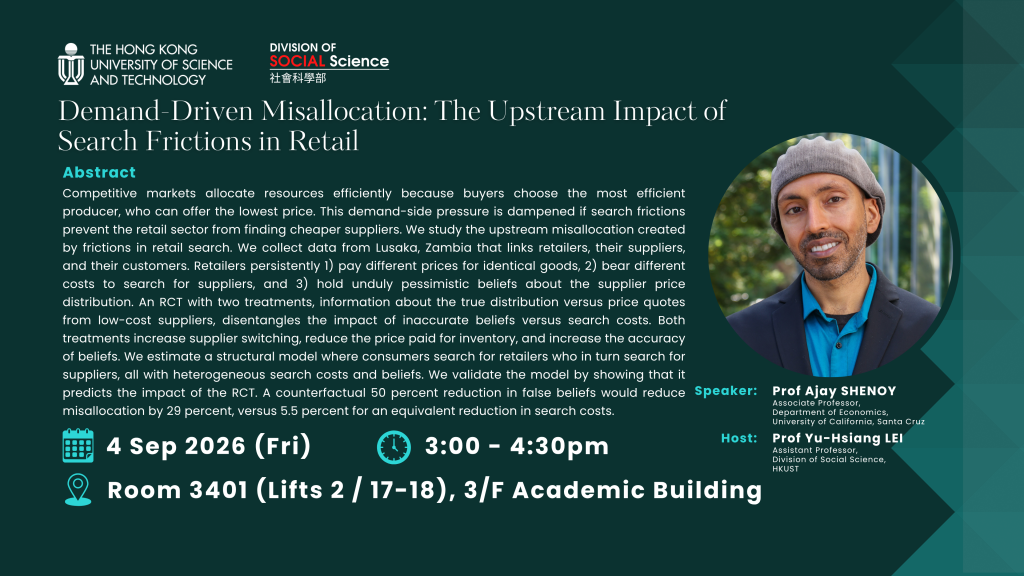
Competitive markets allocate resources efficiently because buyers choose the most efficient producer, who can offer the lowest price. This demand-side pressure is dampened if search frictions prevent the retail sector from finding cheaper suppliers. We study the upstream misallocation created by frictions in retail search. We collect data from Lusaka, Zambia that links retailers, their suppliers, and their customers. Retailers persistently 1) pay different prices for identical goods, 2) bear different costs to search for suppliers, and 3) hold unduly pessimistic beliefs about the supplier price distribution. An RCT with two treatments, information about the true distribution versus price quotes from low-cost suppliers, disentangles the impact of inaccurate beliefs versus search costs. Both treatments increase supplier switching, reduce the price paid for inventory, and increase the accuracy of beliefs. We estimate a structural model where consumers search for retailers who in turn search for suppliers, all with heterogeneous search costs and beliefs. We validate the model by showing that it predicts the impact of the RCT. A counterfactual 50 percent reduction in false beliefs would reduce misallocation by 29 percent, versus 5.5 percent for an equivalent reduction in search costs.
Professor Ajay Shenoy is an Associate Professor in the Department of Economics at U.C. Santa Cruz, a faculty affiliate of the Center for Effective Global Action, and a member of the steering committee of the UC Institute on Global Conflict and Cooperation. His research examines how firms and entrepreneurs in developing countries become more productive, looking at the constraints they face in investing, specializing, and growing, from insecure property rights and risky income to the misperceptions and market frictions that keep resources from flowing to their best use. Much of this work focuses on small retailers and their suppliers, studying how they choose what to sell and how relationships up and down the supply chain shape their productivity. His work in political economy examines how power is won and exercised within political systems, including how electoral districts are drawn, how public resources are directed for political advantage, and how political organizations maintain control over their members. He has published in the Review of Economics and Statistics, the Journal of the European Economic Association, and the Journal of Development Economics among others, and currently serves as an Associate Editor at the Journal of Development Economics. He holds a Ph.D. in economics from the University of Michigan.
Host: Prof Yu-Hsiang LEI, Assistant Professor, Division of Social Science, HKUST